


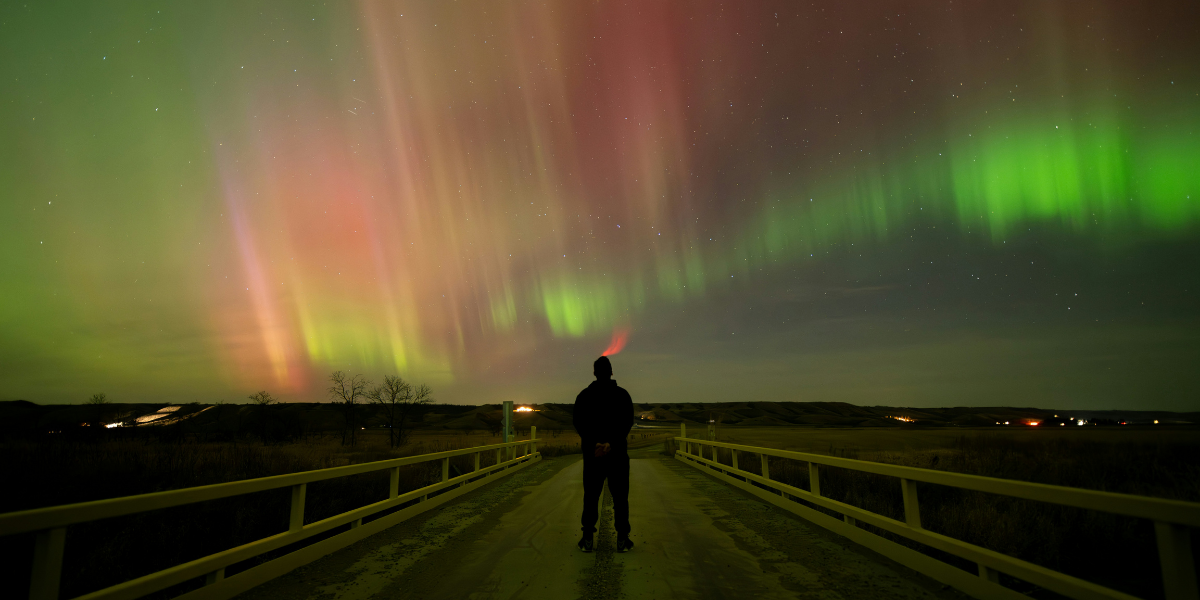
On February 5, 2026, a spectacular natural phenomenon , the aurora borealis , was anticipated to be visible across an unusually wide swath of the United States, offering millions of residents a rare opportunity to witness this vibrant light show in the night sky. This event captured national attention due to its scientific significance and the rare nature of such widespread auroral visibility at mid‑latitudes.
What Caused the Aurora Visibility Event
The expected appearance of the northern lights on the night of February 5 stemmed from a geomagnetic storm triggered by powerful solar activity earlier in the week. Strong solar flares , including intense X‑class flares recorded on February 1 and February 4 , propelled charged particles toward Earth’s magnetic field. These particles interacted with atmospheric gases, creating the luminous auroral displays typically seen closer to the polar regions.
According to space weather forecasts monitored by the National Oceanic and Atmospheric Administration (NOAA) Space Weather Prediction Center, geomagnetic activity was expected to reach levels that could push auroral visibility farther south than usual for observers in the continental United States. NOAA uses the Kp index, a scale measuring geomagnetic disturbances, to forecast auroral potential , with higher values indicating greater chances of widespread visibility.
Where and When to Watch
Experts and meteorologists advised that the best viewing window for the northern lights would be late Thursday night into the early morning of Friday, February 6, especially between 10 p.m. and 2 a.m. local time. The late moonrise on both evenings that week provided darker skies, enhancing the contrast and visibility of the aurora for skywatchers.
Auroral displays are typically confined to high‑latitude regions such as Alaska and northern parts of Canada, but due to this particular geomagnetic event, faint auroras were expected to be potentially visible from up to 21 U.S. states, including northern portions of Oregon, Nebraska, Iowa, Illinois, Indiana, Ohio, New York, Vermont, and New Hampshire. Higher‑latitude residents in northern states such as Minnesota, Wisconsin, and Maine were among those most likely to witness a more vivid and dramatic display.
Scientific and Public Interest Significance
Auroras are not only beautiful; they also signify complex interactions between the sun and Earth’s magnetic field. The phenomenon occurs when solar wind particles collide with gases in Earth’s upper atmosphere, releasing energy in the form of light. These events are monitored by space weather scientists because they can also affect radio communications, satellite operations, and even power grids during the most intense geomagnetic storms.
The likelihood of a widespread auroral display drew significant public interest because such events are relatively rare at lower latitudes. While northern lights are a common occurrence for observers in Alaska and northern Canada, being able to see them as far south as the northern United States is uncommon and typically associated with periods of heightened solar activity.
How to Safely Observe Aurora Displays
For readers hoping to observe the aurora, experts recommended finding a location as dark and free of city light pollution as possible, facing north toward the typical auroral oval. While auroras do not appear during daylight hours, reaching visible intensity in the hours after sunset increases the odds of sighting the phenomenon. High‑quality photos can be captured with long‑exposure settings on cameras or smartphones equipped with night‑mode features.
Broader Context and Solar Activity
This event occurred against the backdrop of an active part of the solar cycle, during which sunspots and flares become more frequent as the sun approaches its solar maximum. Intense solar flares not only enhance the possibility of auroral events but also remind scientists and the public of the dynamic nature of our star and its influence on Earth’s space environment.
Key Takeaways for Readers
- Rare visibility: The aurora borealis was expected to be seen in up to 21 U.S. states , an uncommon occurrence for mid‑latitude regions.
- Prime watching hours: The optimal time was late evening on February 5 into early morning of February 6.
- Scientific relevance: Geomagnetic storms are noteworthy for their effects on Earth’s magnetosphere and technology, beyond their visual spectacle.
- Viewing tips: Dark skies, northern horizons, and night photography techniques can enhance observation experiences.
Overall, the February 5 aurora event offered both an educational and awe‑inspiring display for millions across the United States, underscoring the dynamic interplay between solar activity and Earth’s atmospheric systems.
