

NASA Launches Scientific Balloon Carrying Technology Tests From New Mexico
 A to Z Times Contributor—AUGUST 22, 2026·4 MINS READ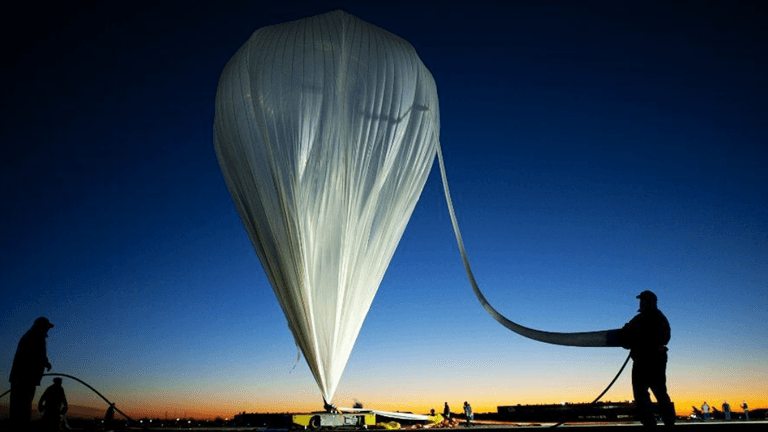
NASA successfully launched a scientific balloon from New Mexico on Saturday, beginning a campaign designed to test equipment at the edge of Earth's atmosphere and support future high-altitude research missions.
The balloon lifted off from NASA's balloon launch facility in Fort Sumner during the morning and climbed to an altitude of approximately 123,000 feet.
The mission, known as the Salter test flight, marked the first scientific balloon flight of NASA's 2026 Fort Sumner campaign.
Unlike conventional aircraft, high-altitude scientific balloons can operate far above commercial aviation routes and reach the stratosphere without requiring a rocket launch. Their relatively low operating costs make them useful for testing instruments and conducting scientific experiments.
The Salter mission was primarily a technology test flight. Its purpose was to evaluate hardware intended for future balloon missions and gather information that can help engineers improve equipment before it is used on more complex flights.
The balloon remained airborne for approximately four hours and eight minutes, providing researchers with an extended opportunity to evaluate the payload under high-altitude conditions.
The flight also carried a secondary educational mission through Cubes in Space. Approximately 100 small student-designed experiments were included as part of the payload.
The student experiments were created by young people between the ages of 11 and 18, allowing them to participate in a real high-altitude research campaign.
The inclusion of student experiments illustrates one of the advantages of balloon missions. Because balloons can carry comparatively small payloads, they can provide opportunities for educational experiments that would be difficult or prohibitively expensive to place on a rocket.
The scientific environment at the balloon's operating altitude is also valuable for research. Conditions in the stratosphere differ substantially from those near Earth's surface, allowing scientists and engineers to test equipment in low-pressure, cold and high-radiation environments.
Technology testing is particularly important for future space missions. Instruments designed for space must operate reliably under conditions that are difficult to reproduce fully on the ground.
A balloon flight can provide an intermediate testing environment before hardware is placed aboard a spacecraft.
The approach can reduce risk by identifying design problems before more expensive missions take place.
Scientific balloons also serve a broader role in NASA's research portfolio. They can support astronomy, atmospheric science, Earth observation and technology development.
Some balloon missions carry telescopes and sensors that observe the universe or Earth's atmosphere from above most of the atmosphere.
Other missions test components intended for future spacecraft.
The Fort Sumner campaign is part of NASA's continuing use of high-altitude balloon facilities to support these activities. New Mexico provides favorable conditions for balloon operations because of its geography, weather patterns and relatively open terrain.
The successful launch therefore represented both a mission milestone and a technology-development opportunity.
The flight also demonstrated how space-related research does not always require a rocket. Balloons can provide researchers with access to the upper atmosphere while allowing payloads to be recovered after flight in many missions.
That recoverability can be particularly useful for testing experimental hardware because engineers may be able to examine equipment after exposure to high-altitude conditions.
The student component of the mission adds another dimension. Programs that allow students to send experiments into real research environments can provide practical experience with scientific design and experimentation.
For the students involved, the flight offered an opportunity to see their work become part of an operational NASA mission.
The mission also reflects the broader development of commercial and government aerospace technology. Modern space programs depend on extensive testing before hardware reaches orbit, and high-altitude balloons can provide a relatively accessible platform for that process.
The Salter flight was not itself a space launch, but its high operating altitude placed the payload in an environment relevant to future aerospace missions.
NASA will use information from the flight to evaluate the tested hardware and support planning for future balloon operations.
The successful launch marks the beginning rather than the end of that process. Engineers must analyze performance data and determine whether the technology behaved as expected.
For NASA, the August 22 flight demonstrated the continuing value of scientific balloons as platforms for research and technology development.
For the students whose experiments traveled aboard the mission, it provided a rare opportunity to participate directly in a NASA flight.
Together, the technology tests and educational payload demonstrate how high-altitude balloon missions can combine engineering research, scientific experimentation and hands-on education in a single operation.

A to Z Times Contributor
This article features partner, contributor, or branded content from a third party. Members of the A to Z Times editorial staff were not involved in the creation of this content. All views and opinions are those of the contributor alone.