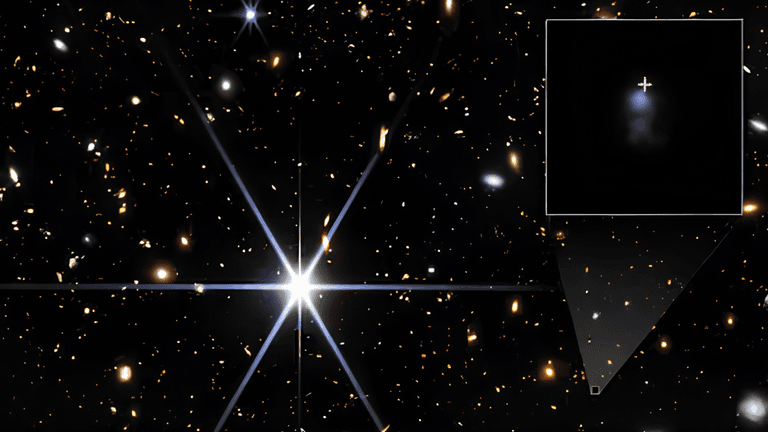
Webb Telescope Identifies Host Galaxy of the Most Distant Known Fast Radio Burst
 A to Z Times Contributor—OCTOBER 8, 2026·4 MINS READ
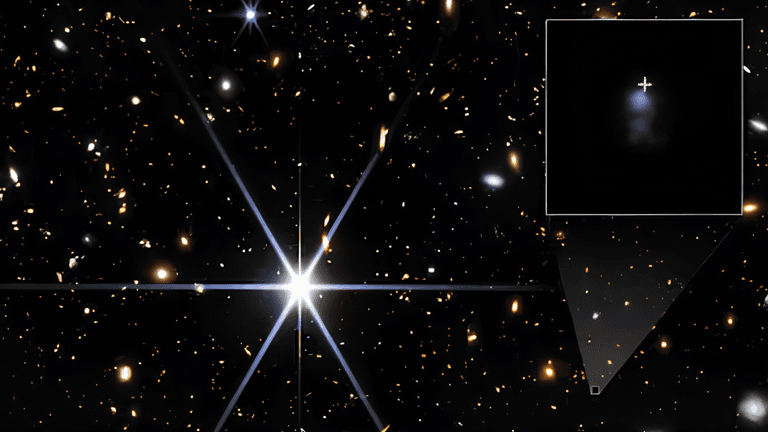
Webb identified the host galaxy of a record-distant fast radio burst, offering new clues about these mysterious cosmic signals and origins.
A Record-Distance Cosmic Signal
NASA and its international partners announced the finding on October 8. Researchers used Webb's infrared observations to identify the galaxy associated with a fast radio burst designated FRB 20240304B.
Fast radio bursts, or FRBs, are intense flashes of radio waves that typically last only milliseconds. Scientists have detected them from distant galaxies, but their origins remain incompletely understood.
The newly studied burst was identified through radio observations by the MeerTRAP team using the MeerKAT telescope. Subsequent observations helped researchers determine where the signal originated and investigate the galaxy associated with it.
Webb's observations confirmed a cosmological redshift of 2.148 for the host galaxy. The burst occurred when the universe was approximately three billion years old, making it a window into an earlier period of cosmic history.
What Makes Fast Radio Bursts Important
Fast radio bursts release intense radio emission over extremely short periods. Their brief duration and immense distances make them difficult to study, particularly when an event is detected only once.
Researchers have proposed several possible mechanisms for producing these signals, including highly energetic processes associated with compact objects. However, scientists have not established a single explanation that accounts for every observed burst.
Locating a burst's host galaxy provides important context. The properties of the galaxy, its stellar population and its environment can help researchers evaluate competing explanations for how the signals form.
The discovery of FRB 20240304B's host galaxy therefore adds a new observational reference point. It does not settle the question of the bursts' origin, but it helps narrow the range of environments researchers can investigate.
How Webb Helped Establish the Distance
The James Webb Space Telescope observes infrared light, allowing astronomers to study distant galaxies whose light has been stretched by the expansion of the universe.
Researchers used Webb's instruments to examine the host galaxy's spectrum. By identifying emission features associated with elements including oxygen and hydrogen, the team could determine the galaxy's redshift.
Redshift measures how light shifts toward longer wavelengths as the universe expands. It provides an important way to estimate cosmological distance and establish when the observed light began its journey.
The measured redshift of 2.148 confirmed that the burst came from a very early period in the universe's history. Because light takes time to travel across cosmic distances, observing the galaxy means studying it as it appeared billions of years ago.
A Small, Actively Star-Forming Galaxy
Webb's observations indicated that the host is a small dwarf galaxy actively forming stars. That characteristic provides researchers with additional information about the environment associated with the burst.
The finding is scientifically useful because astronomers are still investigating how galaxy properties relate to the mechanisms producing fast radio bursts. A small, actively star-forming host offers a different context from what might be expected if all bursts originated in the same type of galactic environment.
However, one host galaxy cannot establish a universal rule. Researchers need observations of many bursts, including their host galaxies, to determine which environmental characteristics are common and which are unusual.
The study contributes another example for comparison as the field develops.
Why International Collaboration Matters
The discovery combined radio observations with infrared measurements and expertise from researchers working across institutions and countries.
Radio telescopes can identify the brief signal and help establish its position. Follow-up observations can then examine the host galaxy in greater detail, allowing scientists to connect the event to a specific astronomical environment.
Webb's contribution illustrates how different observatories can complement one another. No single instrument provides every type of information needed to understand a distant cosmic event.
This approach is increasingly important in astronomy, where rapid signals and transient events may require coordinated observations across multiple wavelengths.
What Scientists Still Need to Learn
Fast radio bursts remain an active research topic because their underlying physical causes are not fully established. The new distance measurement and host-galaxy identification provide evidence, but further observations will be needed to determine how the bursts are generated.
Researchers can compare the properties of additional host galaxies, examine repeated bursts and study how signals travel through the material between galaxies.
The October 8 announcement represents a significant observational milestone because it extends the known range of fast radio burst environments into an earlier era of the universe.
For astronomy, the finding demonstrates the value of combining radio detection with the James Webb Space Telescope's ability to study faint, distant galaxies. It offers a more precise setting for future investigations into one of the universe's still-unresolved phenomena.

A to Z Times Contributor
This article features partner, contributor, or branded content from a third party. Members of the A to Z Times editorial staff were not involved in the creation of this content. All views and opinions are those of the contributor alone.