

Fulvic Gets All the Attention. But What About Humic?
 A to Z Times Contributor—SEPTEMBER 9, 2026·7 MINS READ
Research into humic substances is revealing how fulvic and humic work together, and why their complementary biological roles matter.
Fulvic compounds have become increasingly familiar in the wellness world, largely because of the growing popularity of shilajit. As shilajit moved into the mainstream, fulvic emerged as one of its most talked-about components, drawing attention for its small molecular size, ability to bind with minerals and other nutrients, and interactions with cells and tissues throughout the body.
Yet there is an interesting disconnect. While fulvic is often promoted as one of shilajit's defining components, many shilajit products list the amount of shilajit per serving without identifying exactly how much fulvic that serving provides. Consumers may recognize the word fulvic and associate it with shilajit's benefits without necessarily knowing how much they are actually consuming.
Meanwhile, another important part of the same natural system has received far less attention: humic.
Fulvic is only one fraction of the broader family of humic substances. In nature, fulvic and humic compounds occur together, yet their different molecular structures give them distinct and complementary biological properties.
That raises an important question: if nature provides both, what might be overlooked when nearly all the attention goes to fulvic?
Before Supplements, They Were Part of the Food Chain
Fulvic and humic compounds are not new to human nutrition. Long before supplements existed, they formed naturally in biologically active soils and entered the food chain through plants and foods people consumed.
Over the past century, intensive cultivation, repeated cropping, soil erosion, declining organic matter, and increased reliance on synthetic fertilizers have weakened this natural connection. As soil biology has declined, so has our exposure to naturally occurring humic substances.
At the same time, modern life brings greater exposure to environmental contaminants, heavy metals, agricultural chemicals, and other unwanted substances, making these compounds’ binding and protective properties increasingly relevant.
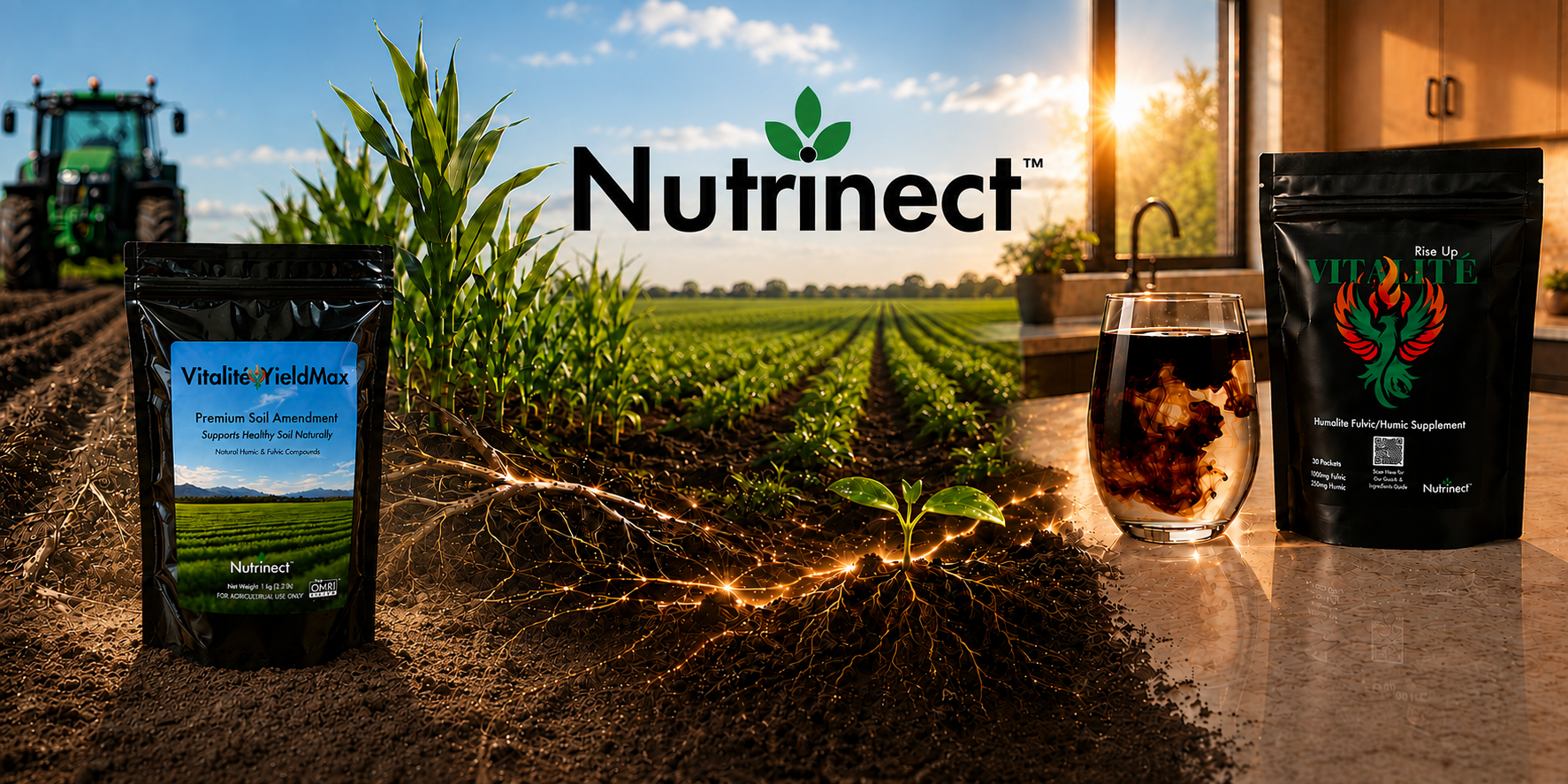
Nutrinect’s YieldMax Humalite helps restore this soil-to-food connection by returning humic and fulvic compounds to soils. Supplementation may represent a return to compounds connected to healthy soil, food, and nutrition.
Fulvic and Humic: Different by Design
Although fulvic and humic compounds belong to the same natural family, they are not the same. Differences in their molecular size and structure influence how each interacts with the human body.
Fulvic compounds are extremely small and highly mobile. They naturally contain trace minerals and micronutrients and can bind with other nutrients, helping carry them throughout the body and making them easier for cells to access and use. Because fulvic can interact readily with cells and tissues, research has also explored its role in hydration, energy production, antioxidant protection, and overall cellular health.
Humic compounds are larger and more structurally complex, with numerous active binding sites that give them different capabilities. They are particularly known for their strong binding and chelating properties, including interactions with heavy metals and research demonstrating binding with glyphosate. These properties contribute to humic's important role in supporting the body's natural detoxification and protective processes. Research has also explored humic compounds' interactions with cells and tissues, gut integrity, immune function, and oxidative balance.
Fulvic and humic work differently, but they work better together. Fulvic helps nourish and support cells, while humic helps protect them and remove what the body doesn't need. Together, their complementary actions create a natural synergy, supporting both what the body needs to take in and what it needs to clear away.
What Humic Brings to the Relationship
Humic substances are especially known for their binding and chelating properties. Research has demonstrated interactions with heavy metals and glyphosate, supporting the body's natural processes for binding, neutralizing, and eliminating unwanted compounds. But humic is much more than a traditional binder.
Research has also explored humic compounds for their ability to interact at the cellular level, help protect cells from oxidative stress, support healthy immune activity, and contribute to mineral and nutrient utilization. Within the digestive system, humic compounds have been studied for their role in supporting the intestinal barrier and helping maintain a healthy gut environment.
Importantly, these actions aren't limited to the digestive tract. Unlike traditional binders that primarily work within the gastrointestinal system, humic compounds have also been studied for their interactions with cells and tissues throughout the body.
This is why simply taking more fulvic doesn't replace humic.
Humic isn't better than fulvic, it brings something different. And simply increasing the amount of fulvic cannot recreate the functions that come from humic's different molecular structure.
The Power Is in the Partnership
Fulvic's small size and mobility allow it to carry minerals and nutrients and interact readily with cells and tissues. Humic brings a different kind of support through its extensive binding and chelating activity, protective properties, and roles in detoxification, gut integrity, and cellular health. Their functions also overlap in important areas, including mineral utilization, antioxidant activity, immune support, and overall cellular function.
Together, those different but overlapping actions create a natural synergy. Fulvic helps nourish and support cells, while humic helps protect them and bind substances the body needs to eliminate. The question isn't whether fulvic or humic is more important. It's what they accomplish together.
That complementary relationship is central to Vitalité Humalite, Nutrinect's wellness formulation, which provides both fulvic and humic compounds rather than emphasizing a single fraction. By keeping both together, Vitalité Humalite is designed to support mineral utilization, cellular hydration and health, gut integrity, healthy immune function, and the body's natural detoxification processes, drawing on the broader range of benefits their synergistic relationship provides.
Why Vitalité Humalite Keeps Both
Vitalité Humalite begins with freshwater Humalite from Alberta, Canada, the purest source of naturally occurring humic and fulvic compounds. While these fractions are often separated and sold individually, Vitalité Humalite takes a different approach: it keeps them together in their natural balance.
Alberta Humalite naturally contains approximately 70% humic and 30% fulvic compounds. Vitalité Humalite uses Fulvic Isolation Technology (FIT™), a patented chemical-free purification process designed to preserve the natural composition of humic substances. By maintaining both fulvic and humic fractions in their original balance, FIT™ removes impurities while protecting the molecular integrity and biological properties that allow the two fractions to work together.
Each serving provides 250 mg of humic compounds and 100 mg of fulvic compounds. The finished powder is tasteless, dissolves easily in water, and contains no fillers, preservatives, artificial ingredients, or proprietary blends. It is also independently third-party tested.
But the reason for keeping both goes beyond preserving a ratio. It preserves the synergistic partnership. Fulvic and humic bring different molecular structures and biological properties to the formulation, allowing Vitalité Humalite to draw on the benefits of both. Instead of choosing the fraction with greater name recognition, the formulation maintains their natural synergy, because the value isn't simply in fulvic or humic alone, but in what they can do together.
From Ancient Use to Modern Understanding
Shilajit has been used in Ayurvedic medicine for thousands of years, long before science could identify the complex humic substances it contains. Its long history of traditional use introduced people to the benefits of these naturally occurring compounds centuries before researchers began examining fulvic and humic at the molecular and cellular level.
Today, shilajit's popularity has helped bring fulvic into the modern wellness conversation. But there is an important distinction: shilajit is a naturally variable substance, and many products identify only the amount of shilajit per serving, not exactly how much fulvic or humic the consumer is receiving.
Fulvic and humic were never meant to compete. They naturally occur together, and their different structures allow them to interact with the body in complementary ways. The important question isn't which one is better, but what each contributes, and what they accomplish together.
That is the principle behind Vitalité Humalite: preserving the broader, synergistic relationship nature created while delivering meaningful, clearly identified amounts of both fulvic and humic compounds from the purest natural source of humic and fulvic substances. Unlike shilajit, which can vary considerably in composition and has raised concerns about contamination and purity depending on its source and processing, Vitalité Humalite is purified and independently third-party tested, with exactly 100 mg of fulvic and 250 mg of humic compounds identified in every serving.
The difference goes beyond ingredients, it’s about purity, consistency, transparency, and preserving both fractions, so they can work together and deliver distinct benefits.
Explore More About Nutrinect
Readers interested in learning more about Nutrinect, the Vitalité product line, and the science behind humic and fulvic substances can visit the company's official website. Additional updates, educational resources, and community news are available through Nutrinect's social media channels, including Facebook, X, and TikTok.
Disclaimer:
This article is for informational purposes only and is not intended to promote, encourage, or provide professional advice related to health, nutrition, or agricultural practices. Always consult a qualified professional or trusted authority before engaging in any activities related to dietary supplements, soil treatments, or regenerative agriculture, especially if doing so may have legal, financial, or personal consequences. The author and publisher are not responsible for any losses, damages, or outcomes resulting from the use or reliance on the information provided.

A to Z Times Contributor
This article features partner, contributor, or branded content from a third party. Members of the A to Z Times editorial staff were not involved in the creation of this content. All views and opinions are those of the contributor alone.