

NASA Research Challenges Existing Understanding of Oxygen Loss in Dwarf Galaxies
 A to Z Times Contributor—NOVEMBER 2, 2026·4 MINS READ
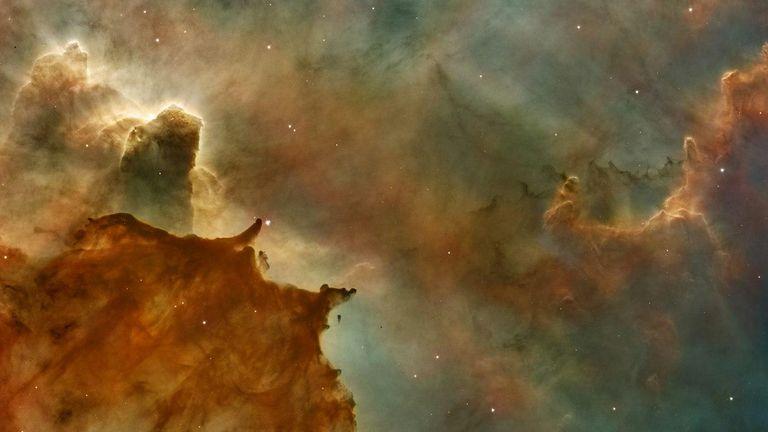
Hubble observations reveal that supernova-driven galactic winds remove more oxygen from small galaxies than scientists previously modeled.
Astronomers have identified a significant difference between predicted and observed oxygen levels in nearby dwarf galaxies, providing new evidence that powerful stellar explosions can remove chemical elements from small galaxies more efficiently than existing models suggest.
NASA announced the findings following research involving its Hubble Space Telescope and 37 nearby dwarf galaxies examined through the Galaxies Losing Oxygen via Winds project.
The investigation found that these galaxies retain only a small fraction of the oxygen produced by their stars. The results offer additional insight into how galaxies develop, how stellar activity changes their chemical composition, and how elements are transported into the space between galaxies.
The research addresses an important question in astrophysics: how do galaxies distribute the heavier elements created by generations of stars?
Investigating the Oxygen Discrepancy
Oxygen is among the most abundant elements in the universe, following hydrogen and helium.
It is produced inside stars through nuclear processes and released into surrounding environments through stellar evolution and explosive events.
Over time, these elements contribute to the formation of new stars, planets, and other astronomical structures.
Scientists use oxygen as an important measurement when studying galactic chemical evolution because its production and detection are comparatively well understood.
However, theoretical simulations predicted that the 37 dwarf galaxies studied should contain substantially more oxygen than researchers observed.
The difference suggested that a significant amount of the material produced by stars had been transported outside the galaxies.
Researchers attributed much of this process to galactic winds associated with massive stars and supernova explosions.
Why Dwarf Galaxies Are Important
Dwarf galaxies are smaller systems containing considerably fewer stars than large galaxies such as the Milky Way.
Their relatively low mass makes them particularly useful for investigating how gravitational forces influence the retention of gas and heavier elements.
In larger galaxies, stronger gravitational forces can help retain material within the system or in surrounding regions.
Dwarf galaxies have weaker gravitational environments, meaning energetic outflows can remove gas and chemical elements more easily.
This makes them important laboratories for examining how stellar activity influences the long-term development of galaxies.
The GLOW project selected nearby systems that were sufficiently close for Hubble to resolve individual stars.
That level of detail allowed researchers to investigate the history of star formation and better understand how oxygen was distributed within each galaxy.
How the Research Was Conducted
The investigation combined several types of astronomical observations.
Researchers used archival optical imaging from Hubble to study stellar populations and reconstruct star-formation histories.
Information from NASA's retired Spitzer Space Telescope also contributed to the analysis, alongside observations from the Very Large Array and the Australia Telescope Compact Array.
These instruments provided complementary information about the stars, gas, and other material associated with the galaxies.
By combining the observations, the team examined oxygen distribution across different galactic environments.
The work was supported by NASA and the National Science Foundation.
The findings were published in The Astrophysical Journal, providing a scientific basis for the agency's announcement.
Supernova Explosions and the Movement of Elements
Massive stars can end their lives in supernova explosions, releasing large quantities of energy and material.
These explosions can generate powerful outflows that transport gas away from the regions where stars formed.
When multiple stellar events contribute to the same process, the resulting winds can affect an entire galaxy.
The new research suggests that these winds remove oxygen from dwarf galaxies more effectively than conventional simulations predicted.
This has implications for how scientists model galaxy formation.
If a galaxy loses more material than expected, the remaining gas available for future star formation may also differ from theoretical estimates.
The chemical composition of the surrounding environment can change as well.
The Question of Where the Oxygen Goes
Although the study provides evidence of substantial oxygen loss, the ultimate destination of the expelled material remains an important area of investigation.
Some oxygen may remain in diffuse gas surrounding galaxies, while other material could travel farther into the intergalactic medium.
Earlier research involving larger galaxies identified oxygen in extended regions of gas outside their main structures.
The GLOW project extends this scientific question to smaller galaxies, where the relationship between gravitational forces and stellar outflows is different.
Understanding the location of the missing oxygen will help scientists build more complete models of galactic evolution.
Future Space Telescopes Could Expand the Investigation
The research also creates opportunities for future observations.
NASA's Nancy Grace Roman Space Telescope is expected to help identify extremely faint and small galaxies across large areas of the sky.
Once suitable targets are identified, researchers may use Hubble and the James Webb Space Telescope to examine their stellar populations in greater detail.
Such observations could help reconstruct how smaller galaxies formed stars throughout cosmic history.
The November discovery demonstrates the continuing scientific value of Hubble's long-running observations.
By identifying a discrepancy between predicted and observed oxygen levels, researchers have strengthened the understanding of how stellar explosions influence galaxies and how the elements produced inside stars become distributed across the universe.

A to Z Times Contributor
This article features partner, contributor, or branded content from a third party. Members of the A to Z Times editorial staff were not involved in the creation of this content. All views and opinions are those of the contributor alone.